

How Multi-Agent Language Models Improve the Creation of Complex Documents
28.10.2025

Data Scientist
Introduction to Multi-Agent Workflows
When using large language models (LLMs) for structured document generation, accuracy and coherence often suffer. This article introduces a multi-agent workflow that addresses these limitations.
In our recently published article “What Is Agentic AI,” we explained how agent-based systems enable large language models to plan, collaborate, and act autonomously. Building on this foundation, multi-agent language models apply these capabilities to structured document generation:
In industries that rely on complex documentation—such as clinical summaries, regulatory submissions, or technical reports—professionals spend hours gathering information, designing structures, and refining wording before a usable draft is even produced. While traditional LLMs can generate fluent paragraphs, they often struggle to maintain structure, accurately convey facts, and consistently convey ideas across long documents.
In this article, we introduce a multi-agent framework that overcomes these limitations by dividing the generation process among specialized AI agents that plan, draft, review, and collaboratively refine content. The result? Well-structured drafts based on real data that enable professionals to move from the initial concept to a document ready for review in a fraction of the time it used to take.
Our Multi-Agent Workflow for Document Creation
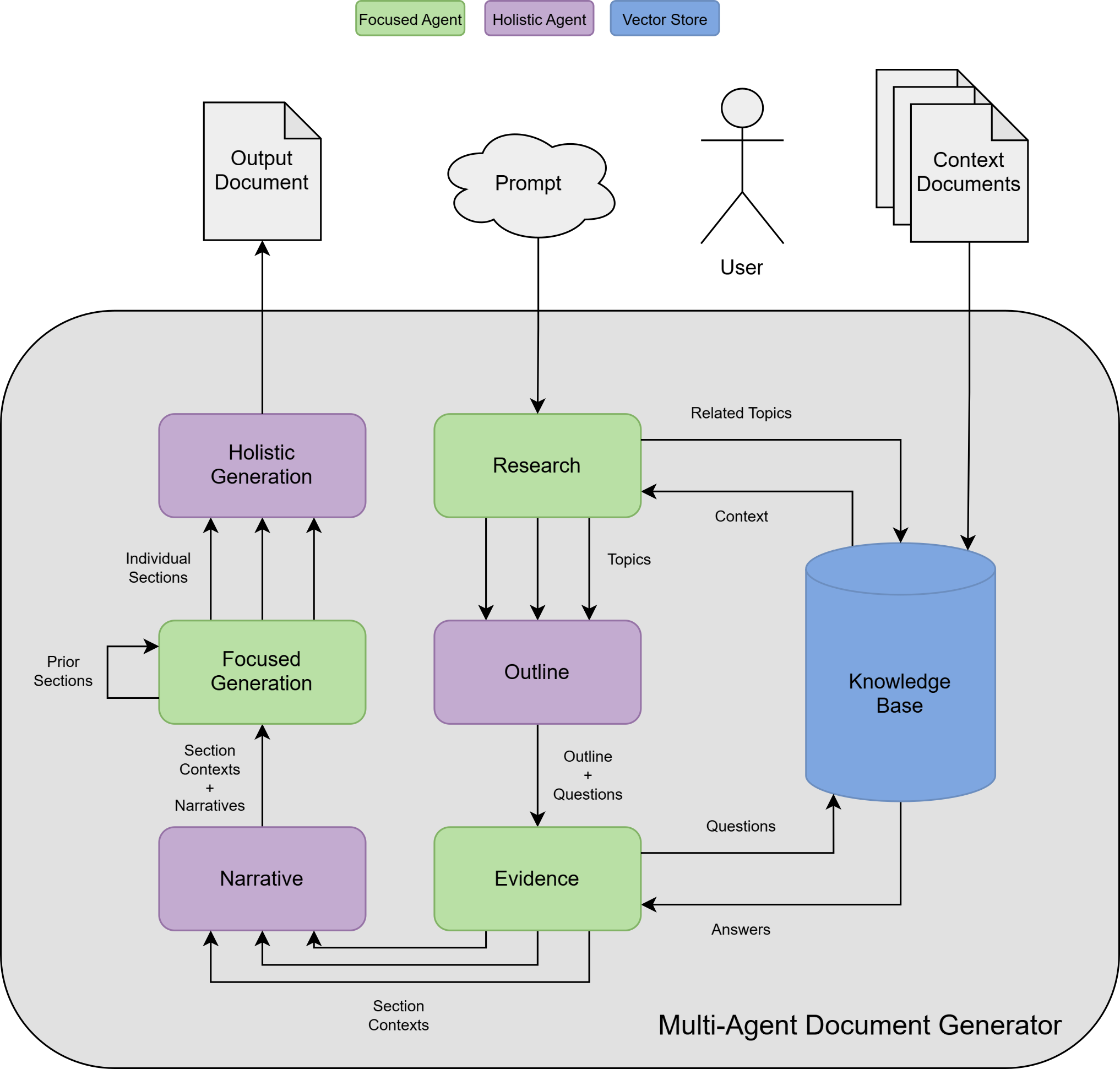
Our system follows a modular multi-agent workflow in which specialized agents handle different phases of document creation—from information gathering and narrative design to final compilation. Each agent operates at a specific level of abstraction: either (F)ocused on details and individual sections or with a (H)olistic view of structure and coherence.
The process begins with the user uploading source documents and requesting the creation of a Type X document on Topic Y. The system then goes through the following steps:
- Knowledge Base (V) – The documents uploaded by the user are processed and stored in a (V)ector database to enable semantic search and evidence-based generation.
- Research Agent (F) – Identifies all relevant subtopics from the user’s knowledge base and uses them to create a structured knowledge map.
- Outline Agent (H) – Creates a structured document outline that ensures complete topic coverage and logical organization.
- Evidence Agent (F) – Retrieves precise evidence for each section to ground the content generation in the sources.
- Narrative Agent (H) – Recognizes thematic relationships between sections and builds a narrative framework across the entire document.
- Focus Agent (F) – Generates detailed, context-aware content for each section based on the outline and supporting evidence.
- Holistic Agent (H) – Assembles the complete document and revises it to ensure clarity, consistency, and completeness.
Together, these agents form a layered system that mimics the working methods of experienced authors (see Figure 1). In the following sections, we take a closer look at the key agents in this process.
The Research, Outline, and Evidence Agents
When we write complex documents, we rarely start typing right away. First, we gather facts and conduct research to ensure that nothing essential is missing. Then we consolidate our knowledge, plan the document’s structure, and decide how the topics will be linked together. Finally, as we write, we check every detail to verify data and references. These three phases are so second nature to us that we hardly notice them—and yet they determine what makes a document complete, coherent, and accurate.
Large language models, however, do not naturally follow this process. They are powerful text generators capable of producing fluent paragraphs, but they struggle with three key requirements that are crucial for reliable document creation:
- Factual completeness: The document must cover all relevant subtopics and include all important information from the provided material without omitting anything essential.
- Structured Thinking and Coherence: The document must be logically structured, with sections that build upon one another—not merely stand side by side as loose summaries.
- Factual accuracy: Every statement must be based on verifiable sources to avoid the models’ well-known “hallucination tendency”—that is, plausible but incorrect information.
Our multi-agent framework addresses these requirements with three specialized components: the Research, Outline, and Evidence agents.
The Research Agent: Ensuring Factual Completeness
Before a document can be written, the language model must understand what the system knows—and what it does not know. The Research Agent is the system’s first step in responding to a user query (e.g., “Write an article on topic X”). In this phase, the agent’s main goal is to build a structured understanding of all available information.
It begins by querying the vector database to find relevant information snippets, which are then grouped into related subtopics based on semantic similarity. Each subtopic is summarized and linked to the corresponding sources, creating a structured overview of the knowledge landscape. To identify knowledge gaps, the agent compares the subtopics found with a general list of expected topics. The result is a prioritized map of existing knowledge—a foundation that helps subsequent agents generate content based on solid information.
Without a structured research phase, the model would attempt to write about topics that are generally relevant but do not appear in the knowledge base at all—while simultaneously overlooking important existing areas. The result would be an incomplete document, filled with fabricated content where precision is required, and lacking details where they are needed.
The Outline Agent: Ensuring a Coherent Structure
Once the model knows what information exists, it must decide how to organize it. The Outline Agent structures the document by creating a hierarchical outline that specifies which sections and subsections the document should contain, how they are related, and in what order they should appear.
However, the agent does more than just name sections—it assigns specific guiding questions to each subsection. These questions serve as goals for subsequent agents and specify what each part of the document is intended to convey. This mirrors the way human authors work, who not only organize content but also define the central ideas to be addressed in each section.
In practice, this step fulfills the same function as the reasoning component of a ReAct module—a method proven to improve the performance of language models by separating thinking (“What should I write about?”) from writing (“How should I phrase it?”). This allows each section to be generated in isolation without losing sight of the overall context.
By establishing both a macrostructure (chapter structure) and micro-guidance (guiding questions), the Outline Agent ensures that the content remains consistent from beginning to end.
The Evidence Agent: Ensuring Factual Accuracy
“Hallucinations”—that is, the tendency of language models to generate fabricated “facts”—are probably the best-known problem associated with the use of LLMs. While this may be tolerable for short, everyday responses, it is unacceptable in highly critical use cases such as regulatory texts, clinical trials, or contractual documents.
The Evidence Agent minimizes this risk by closely linking the generation process to a verified knowledge base. It uses Retrieval Augmented Generation (RAG) to retrieve the most relevant passages for each section according to the plan created by the Outline Agent. These retrievals occur dynamically and are guided by the context of the respective subtopic, ensuring that every generated statement can be traced back to a specific source.
The result is a writing process that is evidence-based and reference-conscious: This ensures not only factual accuracy and traceability but also transparency—a crucial factor for exams, audits, and compliance requirements.
The Narrative, Focus, and Holistic Agents
Even when all the facts are in place and a clear outline exists, the actual writing process is far from over. As human authors, we establish a central theme, adapt the depth of content to the context, and refine the language to create a consistent and engaging document.
LLMs, on the other hand, do not naturally operate at this level of abstraction. Without specific guidance, they face three key challenges in the later stages of document creation:
- Narrative coherence: Even if individual sections are well-written, the document can appear fragmented or redundant if there is no overarching theme connecting the parts into a cohesive whole.
- Depth of content and contextual relevance: Without clear guidelines, LLMs tend to produce generic or superficial text that omits important details or repeats ideas multiple times.
- Document-level consistency: When different sections are generated separately, they often lack a unified tone, consistent terminology, and smooth transitions.
Our system addresses these challenges with three additional agents that operate at the structural, stylistic, and narrative levels of the writing process: the Narrative, Focus, and Holistic agents.
The Narrative Agent: Modeling Dependencies Between Document Sections
Documents are more than the sum of their parts. Even if individual sections are factually correct and logically coherent on their own, a document can seem disjointed if it fails to establish an overarching line of argument or narrative.
The Narrative Agent solves this problem by analyzing the relationships between sections. Based on the outline and the guiding questions, it creates a narrative framework that guides the flow of information throughout the document—that is, it determines which concepts should be introduced early on and which should be developed further as the document progresses.
This step reflects a central aspect of human writing: content is not only organized thematically but also structured as a continuous argument, explanation, or narrative. Without the Narrative Agent, such coherence—if it existed at all—would arise only by chance.
The Focus Agent: Creating Context-Aware Content
When a language model generates an entire document in a single pass, it tends to overlook important details. The sections remain superficial, and specific points are not developed sufficiently.
To avoid this, our system uses the guiding questions, the retrieved context, and the narrative guidelines to generate the document section by section. This ensures that each part receives the necessary attention and depth.
However, this section-by-section generation introduces a new problem: redundancy. Without awareness of the surrounding content, models tend to repeat introductions, restate the same facts, or use similar phrasing multiple times.
The Focus Agent is therefore context-aware—it takes into account the sections already generated while writing and adapts accordingly. The result is detailed, self-contained sections with minimal repetition and clear thematic progression.
The Holistic Agent: Refining the Entire Document
The downside of generating text section by section is that the overall result is often inconsistent: transitions feel jarring, the tone varies, and subtle redundancies remain. This is essentially equivalent to a first rough draft—complete, but not yet polished.
Just as human authors revise their drafts, the Holistic Agent performs a final review of the entire document. It smooths out transitions, standardizes tone and style, and corrects inconsistencies that arise when sections are written independently of one another.
It is also essential that this agent adapts the language and style to the user’s intent—whether formal, technical, or narrative. In addition, it creates an introduction and conclusion to frame the document with a clear purpose and conclusion.
The result is not a patchwork of text, but a cohesive, well-thought-out draft that is convincing in terms of content, language, and structure.
Conclusion: The Future of Multi-Agent LLMs in Document Generation
While today's large language models (LLMs) are capable of generating fluent text, they often struggle to produce long, structured, and fact-based documents.
Our multi-agent framework addresses these weaknesses by dividing the writing process into specialized phases, thereby replicating the workflow of experienced authors.
By combining targeted research, structured planning, evidence-based generation, and holistic revision, the system delivers high-quality drafts that are coherent, complete, and verifiable.
In document-intensive fields where accuracy, clarity, and efficiency are critical, this approach transforms language models from generic text generators into reliable writing assistants.