

Agent-to-Agent Protocol: When Companies Should Use Multi-Agent Systems
30.06.2026

Data Scientist
Motivation
A customer escalation often begins with a simple message:
“This invoice is incorrect. Please review it.”
In a corporate environment, this request can involve customer service, billing, contract review, ERP data, case management, and human approval. A single prototype of an AI assistant might attempt to handle all these tasks on its own. However, a productive enterprise architecture generally cannot do this.
This is exactly where the Agent2Agent (A2A) protocol comes into play. It provides independent AI agents with a standardized way to discover each other, delegate tasks, exchange context, track task progress, and return reliable results. A2A standardizes collaboration between agents, while APIs, workflow engines, and the Model Context Protocol (MCP) remain responsible for business functions, data access, and tool integration.
The official A2A specification describes A2A as an open standard for communication and interoperability between independent AI agent systems. Its objectives include agent discovery, the negotiation of modalities, collaborative task management, and the secure exchange of information—without accessing another agent’s internal state, memory, or tools. The currently published specification is Version 1.0.0.
Management Summary
- A2A standardizes collaboration between agents: discovery, messaging, tasks, artifacts, and secure communication.
- A2A is particularly useful when agents collaborate across teams, platforms, vendors, or security domains.
- MCP connects AI applications and agents with tools, data sources, and workflows, while APIs provide specific business functions and data.
- For productive enterprise use, clear guidelines are required regarding ownership, authentication, authorization, monitoring, versioning, approvals, and the handling of artifacts.
- Companies should start with a specific multi-agent process rather than a large-scale platform rollout.
- For HMS, the key question is: Can the agent landscape be operated, monitored, secured, and further developed over the long term?
Definition
What is the Agent2Agent protocol?
The Agent2Agent protocol enables independent AI agents to communicate and collaborate with one another across different systems, teams, and platforms.
A2A defines a common interaction model. Instead of developing individual point-to-point integrations, agents make their capabilities available through a standardized contract. Other agents can discover these capabilities, send messages, create tasks, receive status updates, and retrieve final results.
However, A2A does not define how an agent works internally. The protocol does not prescribe prompts, memory architectures, LLM selection, planning logic, vector databases, or business APIs. This separation allows teams to expose their agents’ capabilities without revealing their internal implementation.
A helpful rule of thumb is:
A2A serves as an external contract for collaboration between agents—not as a model for their internal architecture.
Why is A2A important for enterprise AI architectures?
A2A is gaining importance because many companies are making the transition from isolated AI assistants to ecosystems of specialized AI agents. Without a common interaction model, such agent ecosystems become increasingly difficult to integrate, monitor, and control.
Most enterprise AI initiatives start with a clearly defined use case—for example, a support assistant, a document analysis agent, or an internal knowledge assistant. Over time, additional specialized agents are added, such as those for invoice verification, contract analysis, compliance, finance, IT operations, or data analysis.
These agents are often developed by different teams, based on different frameworks, run in different environments, or come from different vendors.
The real challenge lies in coordination. Agents need a common standard to answer questions such as these:
- What tasks can this agent perform?
- Who owns the agent?
- What authentication is required?
- What artifacts are returned?
- How are errors, timeouts, or approvals handled?
Once agents become part of business-critical processes, interoperability is no longer just a technical issue, but a central architectural and governance requirement.
A2A, MCP, and APIs: Which layer solves which problem?
A2A, MCP, and APIs complement one another. APIs provide business functions and data, MCP connects agents to tools and context, and A2A coordinates collaboration between agents.
The Model Context Protocol (MCP) is an open-source standard that connects AI applications with external systems such as data sources, tools, and workflows. A2A, on the other hand, addresses a different level: communication and coordination between independent agents. In the announcement for A2A Version 1.0, A2A and MCP are explicitly described as complementary technologies.
A simple rule of thumb is:
- APIs provide what a system is capable of.
- MCP expands the range of tools and resources an agent can use.
- A2A expands the range of other agents an agent can collaborate with.
An example: A customer service agent delegates the resolution of an invoice to a billing agent via A2A. The billing agent uses MCP internally or direct APIs to access ERP data and invoice documents. For the customer service agent, the only important thing is that they can reliably hand off the task, track its progress, and receive the result.
A2A should be used when a remote capability behaves like a standalone agent—that is, interpreting requests, managing tasks, asking follow-up questions, or creating artifacts. For simple database queries, deterministic functions, or brief tool calls, MCP or a direct API is usually the simpler and more efficient solution.
Use Cases
When should companies use A2A?
Companies should consider using A2A when multiple independent agents need to collaborate across team, platform, vendor, or security boundaries.
Simply put: A2A makes sense when collaboration between agents itself becomes an architectural challenge.
In many cases, however, A2A is not necessary, for example when:
- a single assistant can handle the entire process,
- a deterministic function solves the task,
- the agent simply needs access to a tool, or
- the entire workflow is controlled within a single application.
In such scenarios, a single-agent approach, an MCP tool call, a direct API, or an existing workflow engine is often the better choice.
Companies should start with a specific multi-agent process. An escalation process in customer service is particularly well-suited, as it combines business value, specialized responsibilities, existing enterprise systems, and traceability requirements.
How can A2A support a real-world business process?
A2A delivers its greatest value for tasks that require delegation, progress tracking, interim results, and final deliverables.
A typical example is an escalation in B2B customer service:
“Invoice 4711 includes a service fee that we did not agree to. Please review the contract and correct the invoice.”
A possible A2A workflow might look like this:
- The customer service agent identifies the billing agent and the contract agent via their Agent Cards.
- They create A2A tasks for invoice analysis and contract review.
- The specialized agents check their respective systems and return evidence or artifacts.
- An approval agent or a human reviewer decides whether a credit memo may be issued.
- The final artifact contains the decision, a summary of the supporting evidence, the corrected invoice, and a customer-ready response.
This process is far more than a simple tool call. It involves multiple specialized agents, states, intermediate results, potential follow-up questions, and human approvals. It is precisely in such scenarios that A2A’s task and status mechanisms demonstrate their added value.
Details
What does a practical A2A reference architecture look like?
A2A should be located in the Agent Collaboration Layer—between the user-oriented assistants and the layer for tools, data, and workflows.
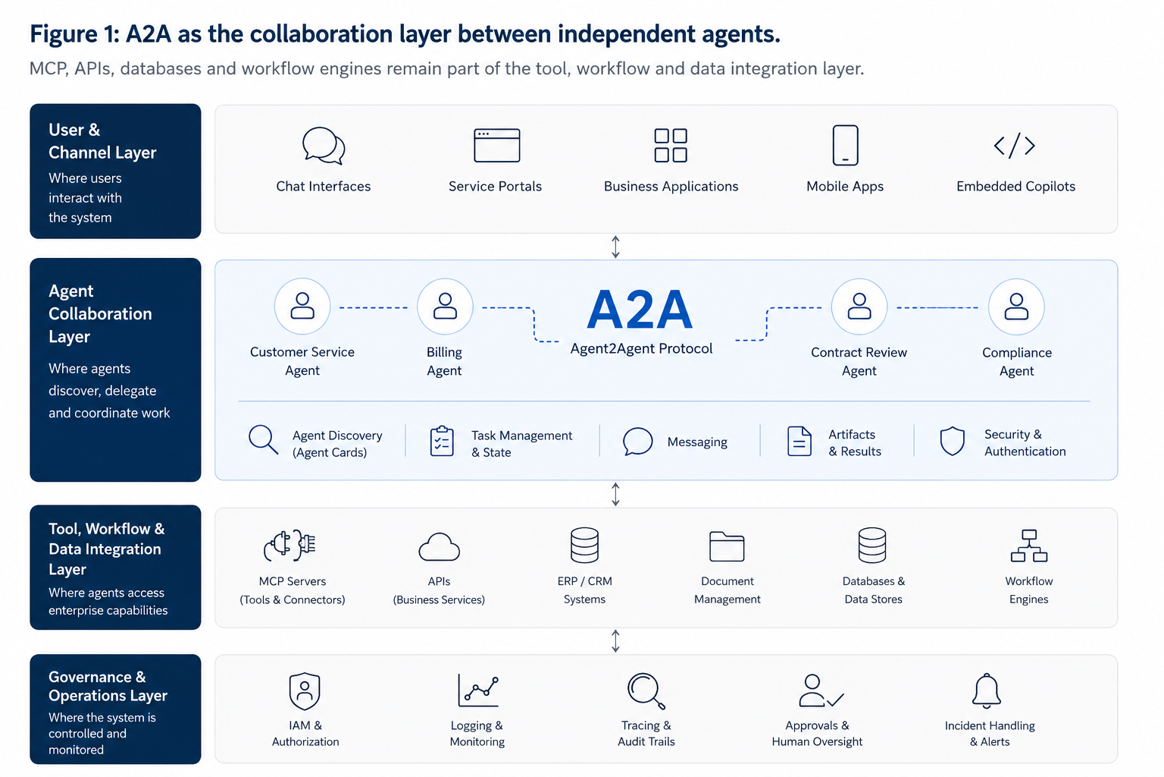
Figure 1: A2A forms the collaboration layer between independent agents. MCP, APIs, databases, and workflow engines remain part of the tool, workflow, and data integration layer.
A2A should not blur the boundaries of an architecture. An agent can expose its capabilities via A2A while simultaneously using MCP to access tools, call APIs for business data, and leverage existing enterprise monitoring solutions for observability.
For HMS customers, this separation is particularly important, as many AI initiatives begin with a promising prototype and must subsequently be developed into production-ready systems. The crucial architectural question is therefore:
Can this agent landscape be operated, secured, monitored, and further developed in the long term?
What governance, security, and observability requirements does A2A entail?
A2A standardizes communication between agents. However, organizations still need clear rules for responsibilities, access control, logging, approvals, and incident management.
The A2A specification describes various enterprise-relevant principles, including authentication, authorization, security, data protection, tracing, monitoring, asynchronous tasks, and opaque execution.
Opaque execution means that agents can collaborate without revealing their internal reasoning, plans, or tool implementations.
Before companies deploy agents for collaboration via A2A, they should answer the following questions, among others:
Observability is particularly important. As soon as agents delegate tasks to other agents, execution is distributed across multiple systems. This makes error analysis and monitoring significantly more complex.
Therefore, every A2A agent should be treated like a production-level enterprise service, with a
- clearly defined person in charge
- versioning
- continuous monitoring
- access control, and
- full auditability.
What mistakes should companies avoid when implementing A2A?
The greatest risk with A2A is not the protocol itself.
The real risk lies in allowing an uncontrolled agent landscape to emerge without clear responsibilities, defined task models, and sufficient observability.
Companies should therefore first set up a small reference implementation before standardizing A2A company-wide.
Even a combination of a customer service agent, a billing agent, and a contract agent is sufficient to validate key aspects such as the quality of agent cards, authentication, logging, task management, artifact formats, and behavior in the event of errors and failures.
A successful pilot provides valuable insights before the architecture is expanded to other business areas.
How mature will A2A be by 2026?
A2A is now mature enough to be seriously evaluated for enterprise multi-agent architectures. Nevertheless, its implementation should always be based on a concrete need for collaboration between agents.
The official specification lists version 1.0.0 as the currently released version. The announcement for Version 1.0 describes it as the first stable and production-ready release and highlights enterprise features such as multi-protocol bindings, version negotiation, multi-tenancy, and signed Agent Cards.
The Linux Foundation reported in April 2026 that A2A is already supported by more than 150 organizations, including AWS, Google, IBM, Microsoft, Salesforce, SAP, and ServiceNow.
For enterprise teams, this means that A2A is now mature enough to be a factor in architectural decisions when independent agents need a common, standardized, and controllable way to collaborate.
The key question, therefore, is not:
“Should we adopt A2A because it’s new?”
But rather:
“Do we have independent agents that need to collaborate across team, platform, vendor, or security boundaries?”
What role can HMS play in the adoption of A2A?
HMS helps companies assess where A2A creates real value, design the appropriate level of collaboration, and develop secure reference implementations for production environments.
The implementation of A2A should not start with the protocol, but rather with the business process and the underlying architectural challenge.
Typical questions to ask at the outset are:
- What agent capabilities already exist?
- Which business process requires more than one specialized agent?
- Which systems, APIs, and data sources are involved?
- Which interactions are stateful, delegated, or cross organizational boundaries?
- What governance measures are required before going live?
- How can an initial implementation demonstrate business value without creating unnecessary platform complexity?
This is where HMS’s expertise in software engineering, data engineering, and AI implementation comes into play.
A2A only delivers its full value when embedded in a robust enterprise architecture. This includes, among other things, integration design, security concepts, observability, testing strategies, deployment, and long-term maintainability.
For many companies, the most sensible first step is a focused architecture assessment or a proof-of-concept implementation. The goal is to identify a business-relevant multi-agent process and demonstrate that it can be operated securely, transparently, and reliably.
Conclusion
The Agent2Agent protocol helps companies make the transition from isolated AI assistants to a coordinated collaboration among multiple specialized AI agents. Its key value lies in the standardization of agent discovery, delegation, task management, status tracking, and the exchange of artifacts between independent agents. Many companies do not recognize the need for A2A until a successful AI prototype evolves into a growing ecosystem of specialized agents. At this stage, individual point-to-point integrations quickly become a bottleneck, while monitoring and governance grow increasingly complex.
The practical recommendation is therefore:
Start with a specific multi-agent process. Define the agents involved, tasks, artifacts, responsibilities, access rules, and monitoring requirements. Only then should you decide whether A2A is the appropriate standard for collaboration among the agents.
Are you planning to build a multi-agent architecture, or would you like to evaluate how A2A and MCP fit into your enterprise AI roadmap?
Schedule an A2A Architecture Assessment with HMS.
Together, we’ll identify a suitable pilot process, define the responsibilities of A2A, MCP, and APIs, and develop a secure reference architecture for production deployment.
Sources and Further Information
[1] Official Agent2Agent Protocol specification: latest released version, core concepts, task model, and enterprise principles.
[2] A2A Protocol v1.0 announcement: production-ready release, enterprise requirements, and relationship to MCP.
[3] Linux Foundation A2A adoption announcement: ecosystem scale, supporting organizations, and cloud-platform adoption.
[4] Official Model Context Protocol introduction: MCP as a standard for connecting AI applications to tools, data sources, and workflows.