

When migrating from SAS to R, business-critical functions and domain logic from legacy SAS codebases must be replicated in a new system environment. A SAS-to-R migration therefore involves more than simply transferring individual blocks of code.
Macros, dependencies, data access, and calculation logic must be analyzed, implemented in R, and reviewed for business accuracy. Companies often use the migration as an opportunity to further develop existing workflows and their analytics architecture. In regulated environments, validation and documentation requirements come into play as well.
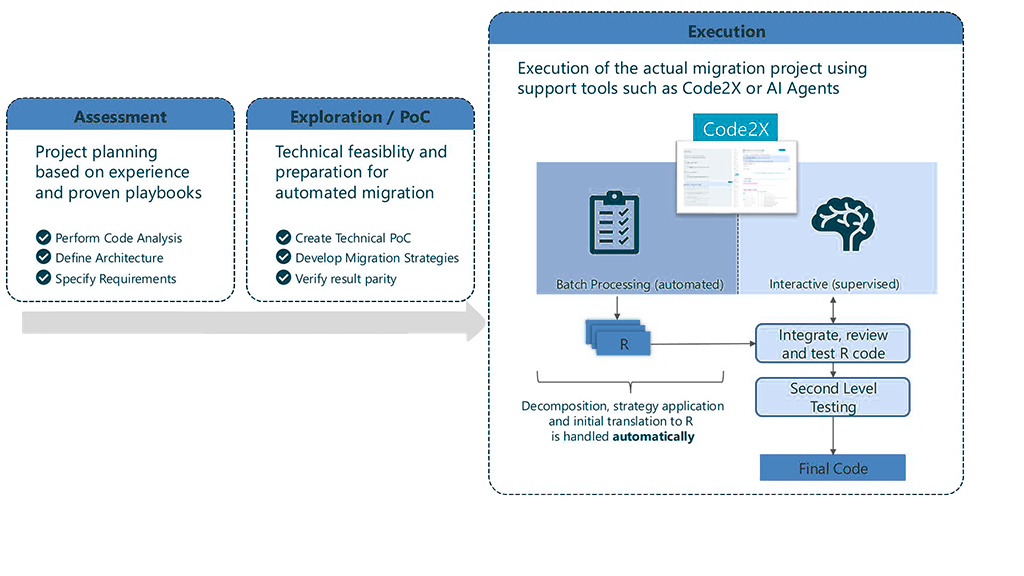
HMS combines AI-driven automation with SAS and R expertise. We support the entire process from code analysis and target architecture through transformation, testing, and integration of the R code into the target environment.
Why SAS-to-R Migration Is Challenging
SAS and R differ in terms of language logic, data processing, and available functions. Macros, formats, data access methods, and implicit dependencies therefore cannot be transferred without proper business and technical context.
Before the migration, it must also be determined how the R code is to be structured, integrated, tested, and operated. The selected packages, interfaces, and validation requirements determine the translation strategies and the subsequent verification of the results.
Proof of Concept
Assessing the Automation Potential of Your SAS Codebase
We examine representative code examples and assess which components can be transformed automatically. Based on this, we can estimate the effort involved, define the target architecture, and define the scope of a potential proof of concept.